


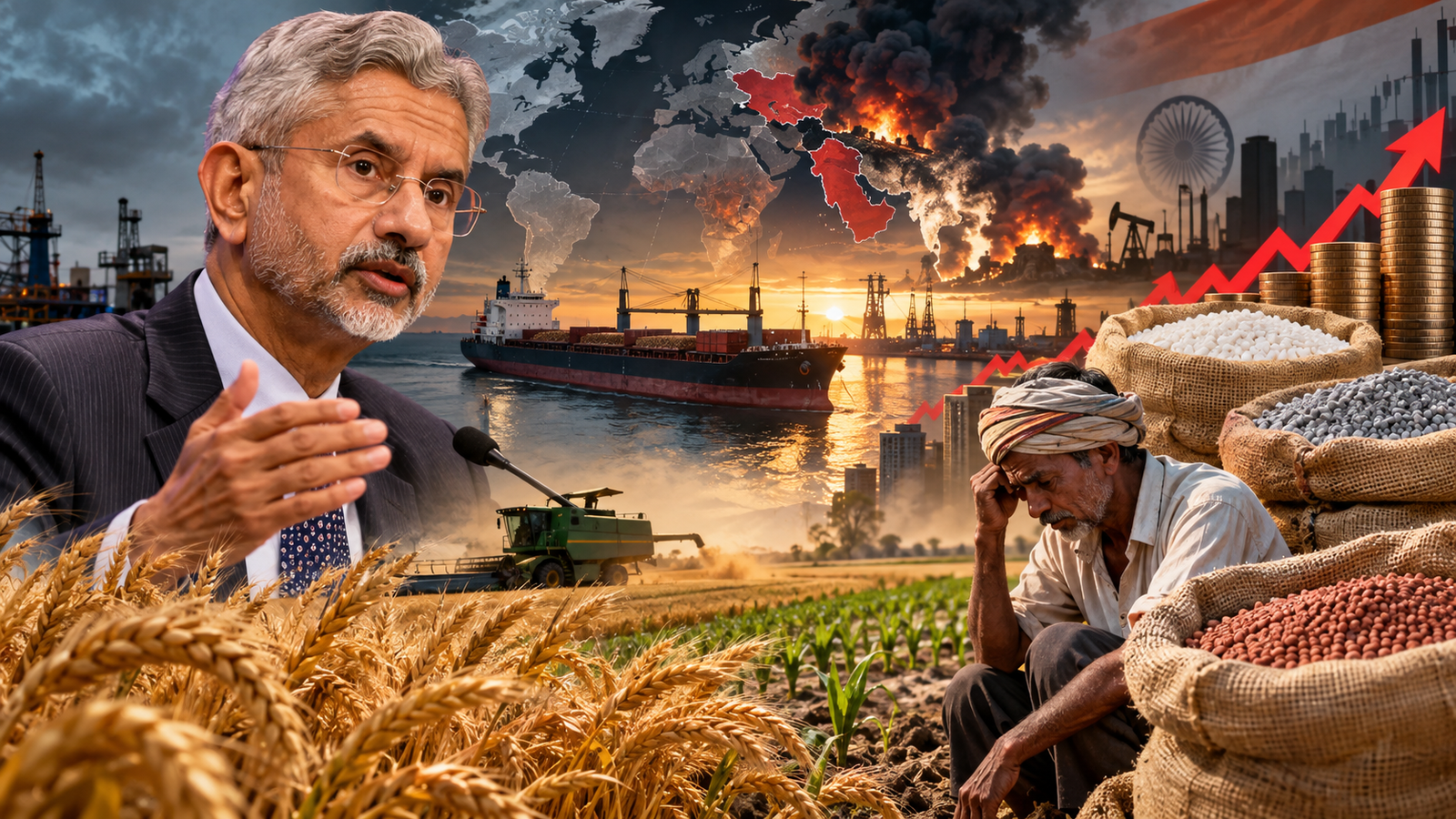
Jaishankar’s Food Crisis Warning: India’s economic outlook is facing another source of uncertainty as geopolitical conflicts, rising international food prices and disruptions in fertiliser supplies raise concerns over global food security. External Affairs Minister S. Jaishankar has warned that the world could face a major food crisis in the coming months, highlighting the economic consequences of the ongoing conflicts in Ukraine and the Iran-Gulf region.
Speaking at an Asia Society event in New York on September 28, 2026, Jaishankar said that disruptions to grain shipments, emerging fertiliser shortages and the possibility of a strong El Niño could intensify pressure on global food supplies. He also highlighted the combined impact of food, fuel, fertiliser and finance pressures on developing economies.
For India, the warning comes at a time when food inflation, agricultural input costs and international commodity prices remain important economic concerns. Although India has substantial domestic foodgrain production and established public procurement systems, its exposure to international energy and fertiliser markets means prolonged global disruptions could affect agricultural costs, consumer purchasing power, government expenditure and the wider economic outlook.
The central question is not whether India is certain to face a food shortage, but how effectively its economy can absorb prolonged external supply shocks while maintaining price stability and supporting agricultural growth.
Jaishankar’s Food Crisis Warning: Global Conflicts Threaten Food and Fertiliser Supply Chains
Jaishankar’s Food Crisis Warning: The Ukraine conflict and the Iran-Gulf crisis have increased uncertainty across important international trade and energy networks. The Black Sea is a significant route for grain exports, while the wider Gulf region plays an important role in global energy and fertiliser trade.
Disruptions to ports, shipping routes, export logistics and energy supplies can increase the cost of transporting agricultural commodities and essential production inputs. Countries that depend on international markets may face higher procurement costs and greater uncertainty over delivery schedules.
Jaishankar’s warning highlights the possibility that major grain exporters may face difficulties in shipping their products, while fertiliser shortages could affect agricultural production in importing countries.
Jaishankar’s Food Crisis Warning: For India, such disruptions could increase the cost of imported fertiliser and energy, particularly if international markets remain under pressure for an extended period. Higher input costs can affect agricultural profitability and may eventually contribute to increased food prices.
However, the effect on India will depend on the availability of domestic supplies, existing inventories, alternative import sources and the duration of geopolitical disruptions.
Rising Food Prices Add Pressure to India’s Inflation Outlook
Food inflation is one of the most direct channels through which global agricultural disruptions could affect India’s economy.
Jaishankar’s Food Crisis Warning: According to the Ministry of Statistics and Programme Implementation, India’s retail inflation, measured by the Consumer Price Index, increased to 4.82% in August 2026 from 4.45% in July. Food inflation, measured by the Consumer Food Price Index, reached 5.95% in August, compared with 5.52% in July. These figures indicate that food prices were already an important source of inflationary pressure before the potential effects of further international supply disruptions.
The rise in global food prices adds another factor for policymakers to monitor. On October 2, the Food and Agriculture Organization reported that its Food Price Index averaged 136.0 points in September 2026, up 1.5% from August and 5.8% higher than a year earlier. The increase was linked to transportation disruptions, weather concerns and higher prices for several crop-based commodities.
If international price increases persist, they could put pressure on India’s food supply chains through higher import costs, agricultural input expenses and transportation charges.
Jaishankar’s Food Crisis Warning: Higher food prices can reduce the purchasing power of households, particularly those that spend a large share of their income on essential food items. This can leave less money available for discretionary consumption, potentially affecting demand across several consumer-facing industries.
Nevertheless, global food prices and India’s retail inflation do not move in a one-to-one relationship. Domestic harvests, government procurement, buffer stocks, import duties and market interventions all influence the extent to which international price changes are transmitted to Indian consumers.
Fertiliser Import Dependence Could Increase India’s Agricultural Costs
Jaishankar’s Food Crisis Warning: Fertiliser availability is another major concern for India’s agricultural sector. Although the country has considerable domestic fertiliser production capacity, it relies on imports to meet part of its requirements for urea, phosphatic and potassic fertilisers, as well as important raw materials.
Government data show that India’s total fertiliser requirement was estimated at 677.18 lakh metric tonnes in 2025–26, compared with 649.43 lakh metric tonnes in 2024–25, an increase of around 4%. The government has relied on domestic production, advance planning and strategic import agreements to maintain adequate supplies for farmers.
However, global price volatility can still affect the cost of securing these supplies. If international fertiliser prices rise, India may face higher import expenditure, even when physical availability remains sufficient.
Jaishankar’s Food Crisis Warning: This creates a potential fiscal challenge because the government provides subsidies to make fertilisers affordable for farmers. Higher international procurement costs may increase the subsidy burden if the government chooses to protect farmers from price increases.
For farmers, rising fertiliser costs can affect production expenses and profitability. Small and marginal farmers may be particularly exposed when input costs increase faster than the prices they receive for their crops.
Jaishankar’s Food Crisis Warning: If high costs persist, farmers may adjust input use, potentially influencing agricultural productivity. The extent of any impact will depend on crop requirements, soil conditions, rainfall, irrigation and the availability of affordable alternatives.
Impact on Indian Farmers and Rural Demand
Jaishankar’s Food Crisis Warning: Agriculture remains an important part of India’s economy, providing livelihoods to a substantial share of the population and supporting demand across rural markets.
Higher fertiliser, diesel, electricity and transportation costs can increase the cost of cultivation. When farmers cannot fully pass these increases on through higher crop prices, their operating margins may come under pressure.
Reduced farm profitability can influence rural consumption and investment. Farmers facing higher costs may postpone purchases of agricultural machinery, consumer durables and other goods, potentially affecting businesses that depend on rural demand.
Jaishankar’s Food Crisis Warning: Rural households also spend on education, healthcare, housing, transport and daily necessities. If rising food prices and agricultural expenses reduce their disposable income, consumption patterns may change.
The impact may extend beyond agriculture into sectors such as consumer goods, two-wheelers, tractors, agricultural equipment and rural financial services.
Jaishankar’s Food Crisis Warning: However, higher agricultural commodity prices can also increase earnings for some farmers who produce and sell crops whose market prices rise. The overall effect on rural income will depend on the balance between higher output prices, increased input costs, crop yields and access to procurement.
Government Subsidies and Fiscal Deficit Risks
Rising fertiliser prices could also increase pressure on India’s public finances.
Jaishankar’s Food Crisis Warning: The government uses fertiliser subsidies to help ensure that essential agricultural inputs remain accessible to farmers at affordable prices. If international prices rise significantly, maintaining existing support levels may require additional budgetary resources.
Higher subsidy expenditure can affect fiscal flexibility, particularly when governments are also managing infrastructure investment, social welfare programmes, food security measures and other development priorities.
Jaishankar’s Food Crisis Warning: If the increase in international costs is temporary, existing budgetary provisions and procurement arrangements may help manage the pressure. However, prolonged price increases could require adjustments in expenditure planning.
The policy challenge is to protect farmers and agricultural production while maintaining fiscal discipline. Measures such as efficient fertiliser distribution, better-targeted support, balanced nutrient use and investment in domestic production can contribute to longer-term resilience.
Energy Prices and the Indian Rupee Could Add to Economic Pressure
Jaishankar’s Food Crisis Warning: The global food crisis warning is also connected to energy markets. International conflicts that disrupt oil and gas supplies can increase energy prices, which in turn influence transportation, industrial production and agricultural input costs.
India’s dependence on imported crude oil makes the economy sensitive to significant increases in global oil prices. Higher oil import expenditure can put pressure on the trade balance and potentially contribute to imported inflation.
Jaishankar’s Food Crisis Warning: A sustained rise in import costs may also affect the Indian rupee, depending on foreign exchange inflows, capital movements and broader market conditions. Currency depreciation can make imported fertilisers, energy and other commodities more expensive in rupee terms.
This creates a possible cycle in which higher international prices and currency movements reinforce one another, increasing the cost of imports and adding pressure to domestic prices.
However, exchange-rate movements depend on several factors, including capital flows, monetary policy, foreign exchange reserves and global financial conditions. An increase in international food prices alone does not determine the direction of the rupee.
Could Rising Inflation Influence RBI’s Monetary Policy?
Jaishankar’s Food Crisis Warning: Food and fuel inflation are important considerations for the Reserve Bank of India because persistent price increases can affect household purchasing power, inflation expectations and overall economic stability.
India’s retail inflation rose to 4.82% in August 2026, while food inflation reached 5.95%, according to official data. These developments highlight the importance of monitoring whether price pressures remain concentrated in selected commodities or spread across a wider range of goods and services.
Jaishankar’s Food Crisis Warning: If inflationary pressures become persistent and broad-based, the RBI may face a more challenging policy environment. Higher interest rates can help moderate demand and manage inflation expectations, but monetary policy cannot directly resolve physical shortages of fertilisers, grain or energy.
The RBI must also consider economic growth, credit conditions, investment and employment when making policy decisions.
A supply-side shock may therefore require a combination of monetary measures, agricultural policies, trade facilitation and targeted fiscal support rather than relying on interest rates alone.
El Niño Could Create Additional Risks for Indian Agriculture
Jaishankar’s Food Crisis Warning: Climate uncertainty is another factor in Jaishankar’s warning. El Niño can alter rainfall and temperature patterns across different regions, potentially affecting agricultural output and water availability.
For India, rainfall conditions are particularly important for crops that depend on the monsoon and for regions where irrigation infrastructure is limited.
Unfavourable weather conditions could affect sowing, crop development and yields, although the effects vary across regions and agricultural seasons.
A combination of lower-than-expected production in some areas and higher international fertiliser or energy costs could increase uncertainty for farmers and policymakers.
Jaishankar’s Food Crisis Warning: India’s response will depend on irrigation access, crop diversification, agricultural technology, weather forecasting and the ability to provide timely support where necessary.
Climate-resilient agriculture and efficient water management can help reduce the economy’s vulnerability to weather-related production shocks.
India Has Important Buffers Against a Global Food Crisis
Despite the risks, India has several mechanisms that can help protect domestic food security.
Jaishankar’s Food Crisis Warning: Domestic foodgrain production, public procurement, food reserves, subsidised distribution and diversified import arrangements can help moderate the effects of international market disruptions.
The government’s advance planning for fertiliser procurement and agreements with international suppliers also support supply security. According to the Department of Fertilizers, long-term arrangements with major producing countries have been used to strengthen India’s supply chain.
Jaishankar’s Food Crisis Warning: These measures provide important protection, although their effectiveness depends on timely implementation, adequate availability, efficient distribution and the scale of any external shock.
India’s economic resilience will also depend on the performance of manufacturing, services, investment, exports and domestic consumption. Food and fertiliser disruptions could create additional pressure, but they do not independently determine the country’s overall growth trajectory.
Economic Outlook: What to Watch in the Coming Months
Jaishankar’s warning highlights the possibility that geopolitical tensions, agricultural supply disruptions and climate-related uncertainty could create overlapping risks for India and the wider global economy.
The key indicators to monitor include international wheat and fertiliser prices, crude oil prices, shipping conditions in the Black Sea and Gulf regions, domestic crop forecasts, food inflation and the government’s fertiliser subsidy expenditure.
Jaishankar’s Food Crisis Warning: For India, the immediate priority is to maintain stable agricultural input supplies, protect food affordability and manage any increase in external costs. Continued monitoring of domestic production, procurement and market prices will be important for identifying emerging pressures early.
The global situation remains uncertain, and a possible food crisis should not be interpreted as confirmation of an inevitable shortage in India. Domestic production, public policy and international market developments will all play a role in shaping the outcome.
Jaishankar’s warning nevertheless highlights a wider economic reality: food security is closely connected to energy markets, international trade, agricultural inputs, public finances and household purchasing power.
The possible global food crisis presents India with a combination of agricultural, inflationary and fiscal risks. Disruptions to fertiliser supplies, rising energy costs, uncertain grain shipments and adverse weather conditions could affect production expenses, food prices and rural demand if they persist.
India’s domestic agricultural capacity, procurement systems, fertiliser planning and food distribution mechanisms provide important safeguards. The challenge will be to strengthen these buffers while maintaining price stability, supporting farmers and protecting economic growth.
The coming months will be important in determining whether global supply disruptions remain temporary market pressures or develop into more sustained challenges for India’s economy.
For more insights into India’s economic outlook, explore our latest updates on Macromap.
You can also explore our related coverage on Indian Express.