





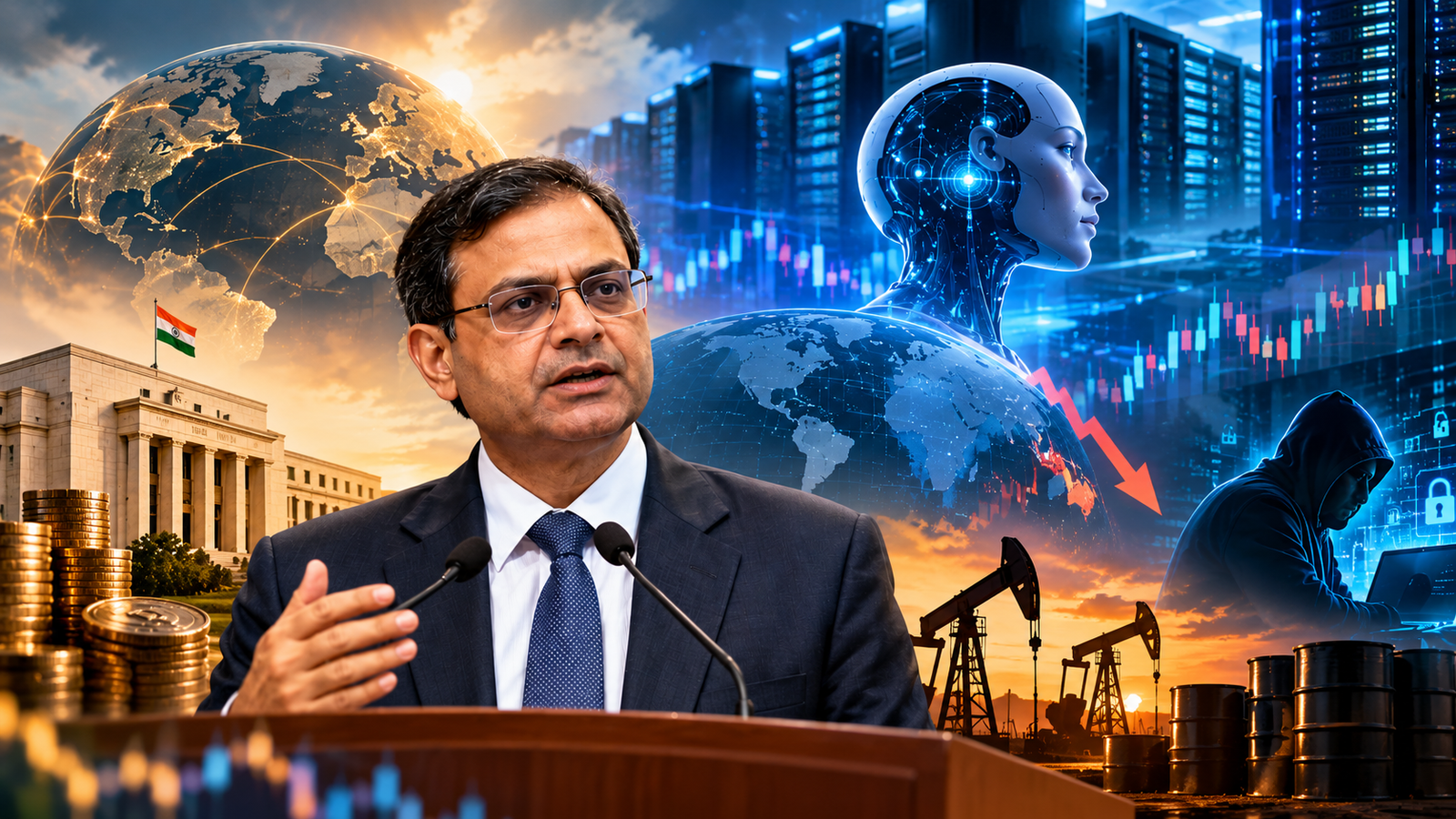
RBI Governor Sanjay Malhotra has flagged five major global financial risks, including rising debt, AI valuations, high leverage, private credit and cyber threats, urging India to strengthen financial resilience.
RBI Governor Flags Emerging Threats to Global Financial Stability
Reserve Bank of India (RBI) Governor Sanjay Malhotra has cautioned that the current strength of India’s financial system should not lead to complacency, warning that emerging global risks could create significant challenges for financial stability. Speaking at the 5th Kautilya Economic Conclave in New Delhi on October 3, 2026, Malhotra identified five major vulnerabilities facing the global financial system: elevated global debt, stretched valuations of artificial intelligence (AI)-related assets, rising leverage, risks in private credit markets and increasing cybersecurity threats.
The RBI Governor said that although India’s banking and financial system remains resilient, prolonged periods of financial stability can encourage excessive risk-taking and weaken financial discipline. He emphasised that financial shocks can emerge rapidly but may take several years to resolve, making continuous monitoring and preparedness essential.
Malhotra’s remarks come amid geopolitical uncertainty, the ongoing West Asia conflict, elevated commodity prices, changing global financial conditions and rapid technological developments. These factors are increasingly interconnected and can transmit financial stress across borders.
According to reports published on October 3 by Financial Express, Business Standard and The Economic Times, Malhotra stressed that policymakers should focus not only on preventing financial shocks but also on ensuring that financial institutions and markets can withstand disruptions without interrupting essential services.
Five Major Risks Identified by the RBI Governor
Malhotra highlighted five areas that could affect global financial stability. While he did not indicate that an immediate financial crisis was underway, he warned that the simultaneous occurrence of multiple risks could place considerable pressure on the international financial system.
1. Rising Global Debt and Higher Borrowing Costs
Elevated global debt is one of the key vulnerabilities identified by the RBI Governor. Governments and businesses across the world have accumulated significant debt, and rising borrowing costs can make it more difficult to service existing obligations.
RBI Governor: Malhotra noted that global debt levels have increased, debt maturity periods have shortened in some areas, and bond yields have hardened. Higher interest rates and yields can increase the cost of refinancing debt, putting pressure on government budgets and corporate cash flows.
When governments face higher interest payments, they may have less fiscal space available for infrastructure, healthcare, education and other public expenditure. Countries with high debt burdens may also find it difficult to respond to unexpected economic shocks through additional spending.
RBI Governor: Higher borrowing costs can affect businesses as well. Companies that rely heavily on debt may face greater interest expenses, lower profitability and reduced capacity to invest. If financial conditions tighten sharply, some firms may struggle to meet their repayment obligations.
The RBI Governor also pointed to risks for banks holding sovereign bonds. A significant rise in bond yields can reduce the market value of existing bonds, potentially creating mark-to-market losses. Such losses may weaken financial institutions, particularly when governments themselves have limited capacity to provide support.
Emerging economies could face additional pressure if international investors withdraw capital in response to changing global interest rates. Countries with substantial foreign ownership of sovereign debt may be especially exposed to sudden capital outflows and currency volatility.
2. Stretched AI-Related Asset Valuations
The second major risk highlighted by Malhotra relates to rising valuations of companies connected to artificial intelligence.
RBI Governor: AI has attracted substantial investment from technology companies, financial institutions and investors. Spending on data centres, advanced computing infrastructure, semiconductors and AI-related software has contributed to market enthusiasm, particularly in advanced economies.
The RBI Governor acknowledged that the AI investment cycle has supported global financial markets. However, he warned that the market’s expectations could become vulnerable if investment growth slows or earnings fail to meet expectations.
If AI-related companies experience slower revenue growth, weaker cash flows or reduced investment, investors may reassess the value of their shares and other financial assets. This could lead to a sharp repricing of AI-related securities and increased volatility in financial markets.
The risk could become more serious if investors and financial institutions have borrowed heavily to invest in AI-linked assets. In such circumstances, a decline in asset prices may lead to forced selling, additional losses and tighter financial conditions.
RBI Governor Malhotra also noted that a correction in AI-related valuations in advanced economies could potentially redirect some international capital towards India. However, such a movement is not guaranteed, as capital flows also depend on global risk appetite, relative returns, exchange rates and broader economic conditions.
For India, the development of AI presents both opportunities and financial risks. Investment in technology can support productivity, innovation and new business models, but excessive market expectations may create vulnerabilities if they are not supported by sustainable earnings and productive capacity.
3. Rising Leverage in Financial Markets
The third concern is the expansion of leverage across equity and bond markets, particularly among non-bank financial intermediaries.
Leverage refers to the use of borrowed funds to increase the size of an investment or financial position. It can increase returns when markets move in an investor’s favour, but it can also magnify losses when asset prices decline.
According to Malhotra, hedge funds, option sellers, exchange-traded funds and other non-bank financial intermediaries have expanded leverage in pursuit of higher returns. This creates potential vulnerabilities when asset valuations are already elevated.
If financial markets experience a sudden correction, highly leveraged investors may be required to provide additional collateral or reduce their positions. This can lead to forced selling, which may push asset prices lower and trigger further losses for other market participants.
The risk is not limited to non-bank financial institutions. Banks and non-bank financial institutions are interconnected through lending, funding arrangements, derivatives and other financial exposures. Stress in one part of the system can therefore spread to other institutions and markets.
Malhotra warned that deeper interconnectedness between banks and non-bank financial intermediaries could amplify the effects of a financial shock. A tightening of financial conditions may affect liquidity, credit availability and investor confidence across multiple segments of the financial system.
For regulators, this highlights the importance of monitoring financial risks beyond traditional banking institutions and assessing how leverage and interconnected exposures may behave under stressed market conditions.
4. Private Credit Market Vulnerabilities
Private credit was another important risk highlighted by the RBI Governor.
Private credit generally refers to loans provided by non-bank lenders and investment funds directly to businesses, often outside conventional public bond markets and traditional bank lending channels.
Private credit has become an important source of financing for companies in several advanced economies. It can provide borrowers with alternative funding options and offer investors access to potentially attractive returns.
However, the market can also involve risks related to lending standards, transparency, borrower concentration, valuation practices and liquidity.
Malhotra pointed to high-profile defaults in the private credit sector as signs of potential vulnerability. Weak lending standards and inadequate assessment of borrower risks can increase the likelihood of defaults, particularly when economic conditions deteriorate.
Unlike publicly traded securities, many private credit investments are not frequently traded in open markets. This can make it more difficult to assess their value during periods of financial stress.
If borrowers face lower revenues, higher interest expenses or refinancing difficulties, defaults may rise. Losses could affect private credit funds and investors, while interconnected exposures may transmit some of the stress to the wider financial system.
The RBI Governor’s comments underline the importance of appropriate risk assessment, reliable data and effective oversight of non-bank financial activities. Private credit can contribute to financial diversification, but its expansion needs to be supported by prudent lending practices and adequate risk management.
5. Cybersecurity Threats and AI-Driven Financial Risks
Cybersecurity was described by Malhotra as one of the most immediate concerns for financial stability.
Banks, payment systems, financial markets and technology providers increasingly depend on interconnected digital infrastructure. This dependence enables faster transactions and more efficient financial services, but it also creates vulnerabilities to cyberattacks, system failures and technological disruptions.
The RBI Governor warned that increasingly sophisticated AI tools could heighten cyber risks, model risks, third-party dependence and the potential erosion of human oversight and accountability.
AI can be used to improve fraud detection, automate risk assessments and strengthen cybersecurity systems. At the same time, advanced AI tools can potentially be misused to support more sophisticated cyberattacks, fraudulent activities and manipulation of digital systems.
Financial institutions also rely on third-party technology providers for cloud services, data processing, payment infrastructure and other essential operations. A disruption at a major service provider could therefore affect multiple financial institutions at the same time.
In highly interconnected financial systems, cyber incidents can spread beyond national borders. A major disruption to payment infrastructure or critical financial services could undermine public confidence and interrupt economic activity.
Malhotra stressed the importance of preserving human oversight, improving technology risk management and ensuring that innovation does not weaken trust in the financial system.
For India, the growing use of digital payments and technology-based financial services makes cybersecurity preparedness particularly relevant. Financial institutions need to strengthen their security systems, monitor third-party dependencies and prepare for operational disruptions.
India’s Financial System Remains Resilient, Says RBI Governor
Despite highlighting several international risks, Malhotra said India’s financial system remains resilient, supported by healthy balance sheets among banks and non-banking financial institutions.
He noted that India has experienced a period of financial stability, supported by relatively low inflation, strong economic growth and prudent fiscal management. However, he cautioned that current resilience does not guarantee immunity from future shocks.
RBI Governor: India remains exposed to developments in the global economy through international trade, commodity prices, capital flows and exchange-rate movements. The ongoing conflict in West Asia has added to concerns about energy prices and external-sector pressures.
Higher global energy prices can increase India’s import bill, place pressure on domestic inflation and affect the current account. If global financial conditions tighten, foreign portfolio investment may become more volatile, affecting domestic equity and bond markets.
RBI Governor: Malhotra said India is taking steps to strengthen its resilience, including diversifying import sources, increasing self-sufficiency in energy and other critical resources, building strategic petroleum reserves, accelerating the energy transition, strengthening domestic manufacturing and expanding access to international markets through trade agreements.
These measures can help reduce exposure to external disruptions over time, although their effectiveness depends on implementation, investment and broader economic conditions.
Why Financial Stability Matters for India’s Economy
RBI Governor: Financial stability is essential for maintaining the smooth functioning of the economy. Banks and other financial institutions channel savings into productive investment, provide credit to businesses and households, and support domestic and international payments.
When the financial system is stable, businesses can access funding, households can obtain financial services and investors can make decisions with greater confidence.
However, financial instability can disrupt these activities. A major banking or market shock may reduce credit availability, increase borrowing costs, weaken consumer confidence and delay investment.
For a growing economy such as India, maintaining financial stability is important for sustaining economic activity, encouraging investment and supporting long-term development.
The RBI plays an important role through banking regulation, supervision, monetary policy, payment-system oversight, liquidity support and other responsibilities. Malhotra highlighted the importance of using these functions to identify emerging vulnerabilities and take timely corrective action.
RBI Governor: He also stressed that the next financial crisis may not necessarily begin within a bank or even within the financial sector. It could originate from a geopolitical event, cyberattack or technological failure before spreading through financial and economic connections.
This means policymakers need to monitor a wider range of risks and understand how shocks can move between institutions, markets, industries and countries.
RBI Governor Outlines Priorities for Policymakers
RBI Governor: Malhotra emphasised that policymakers should focus on strengthening the financial system’s capacity to absorb shocks rather than assuming that every disruption can be prevented.
His address highlighted several priorities:
Building resilience: Financial institutions should maintain sound balance sheets, effective risk management systems, adequate liquidity and operational preparedness to continue providing essential services during periods of stress.
Improving scenario analysis: Regulators and financial institutions need to assess a broader range of possible shocks, including geopolitical disruptions, technological failures, cyberattacks and sudden changes in global financial conditions.
Strengthening data collection: Better and more granular data can help policymakers identify emerging vulnerabilities, understand interconnected exposures and improve the quality of risk assessments. Data on non-bank financial institutions, cross-border positions and technological dependencies is particularly relevant.
Ensuring system-wide resilience: Financial stability should extend beyond banks to include non-bank financial institutions, financial markets, payment systems, technology infrastructure providers and critical third parties.
Supporting responsible innovation: Technologies such as AI and tokenisation can improve efficiency and access to financial services. However, innovation must preserve trust, financial integrity, settlement certainty and appropriate oversight.
These priorities reflect the need for a financial stability framework that responds to the changing structure of the global economy and the growing role of technology and non-bank financial institutions.
What the Warning Means for Investors and Businesses
The RBI Governor’s remarks have implications for investors, businesses and financial institutions, although they do not amount to a prediction of an imminent crisis.
For investors, the warning highlights the importance of understanding the risks associated with high valuations, borrowed investment positions and changing global interest rates. A correction in one asset class can sometimes affect other markets when financial institutions and investors are interconnected.
RBI Governor: Businesses may face higher financing costs if global borrowing conditions tighten. Companies with high debt levels may be particularly sensitive to increases in interest rates or reductions in cash flow.
Financial institutions need to assess exposures not only to direct borrowers but also to market-based risks, technology providers and other connected entities. Stress testing and contingency planning can help institutions prepare for disruptions.
For policymakers, the central challenge is to maintain financial stability while allowing productive investment, innovation and credit growth to continue.
The Governor’s comments do not suggest that all these risks are currently materialising at once. Rather, they identify vulnerabilities that may become more consequential if several shocks occur simultaneously.
Outlook: Vigilance and Preparedness Remain Important
The RBI Governor’s warning comes at a time when the global financial system is adapting to geopolitical changes, higher debt levels, rapid technological transformation and evolving sources of credit.
India’s relatively resilient financial position provides a foundation for managing external pressures, but maintaining that resilience requires continuous supervision, reliable data, prudent financial practices and effective crisis preparedness.
The five risks identified by Malhotra—global debt, AI-related asset valuations, leverage, private credit and cyber threats—are connected through the broader financial system. A shock in one area could affect other institutions and markets, particularly when leverage and cross-border exposures are significant.
For India, the focus will remain on preserving financial stability, strengthening institutional resilience and ensuring that technological innovation supports rather than undermines trust in financial services.
The RBI Governor’s central message is that financial strength should not lead to complacency. Although India is not currently showing the immediate signs of stress described in his remarks, proactive risk management and preparedness will remain important in a rapidly changing global economic environment.
Read more updates on India’s banking sector, monetary policy and global economic developments on MacroMap.
For further insights into global financial risks and India’s financial stability, readers can explore the latest reports and updates from the Reserve Bank of India (RBI) and the International Monetary Fund (IMF).